
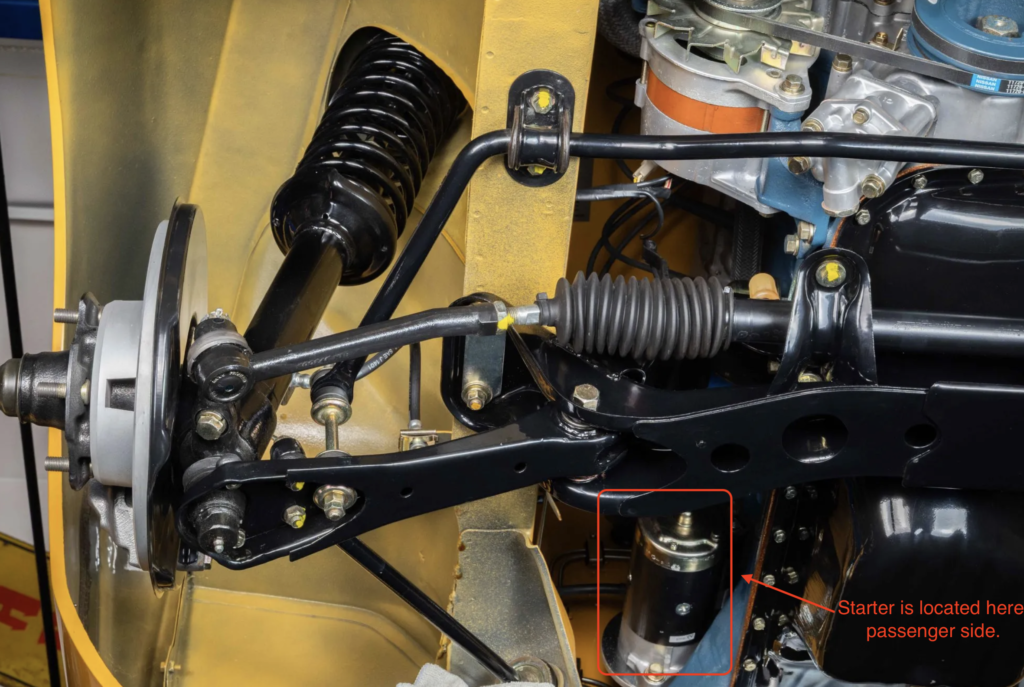
The starter on the 240Z sits low on the passenger side of the engine where it meets the transmission. It’s easy to access from underneath and doesn’t require removing anything else, which makes this one of the more straightforward jobs on the car.
If the car clicks but doesn’t crank, or does nothing at all when you turn the key (and you know the battery is good), the starter is one of the first things to check.
Replacement Starter
This is the one I would use:
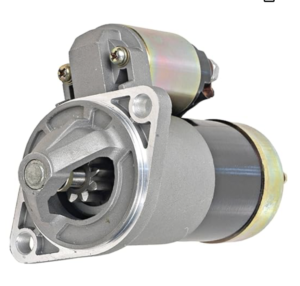
It’s a direct replacement for the original L24 starter. There are a few variations out there, but as long as the mounting pattern and terminals match what you have, you’re fine.
Getting Access
You’ll want the front of the car in the air. It’s technically possible from above, but it’s awkward and not worth it.
From underneath, look up at the passenger side of the bellhousing. The starter is bolted directly into it and is easy to spot — cylindrical body with the solenoid attached.
Before You Start
Disconnect the battery. The large cable going to the starter is always live and it’s very easy to short it while working.
Starter Wiring
Before you remove anything, take a second to look at how your current starter is wired. It’s simple, but it’s also one of the easiest places to make a mistake.
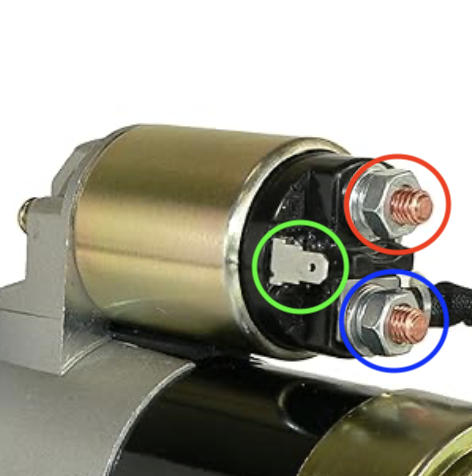 Using the image above:
Red circle — Main battery cable (+12V)
This is the thick cable coming directly from the battery. It goes on the large stud on the solenoid and is always live. On some cars you may also have an additional ring terminal here feeding other circuits. Everything stacked here stays together on reinstallation.
Green circle — Signal wire from ignition
This is the smaller connection that tells the starter to engage when you turn the key. It only gets power in the “start” position. On most 240Zs this is a black/yellow wire. This connects to the small spade terminal.
Blue circle — Starter motor terminal (internal connection)
This is the second large stud on the solenoid. You typically do not connect anything to this externally. It feeds power from the solenoid into the starter motor when engaged. If you see a wire here, it’s worth double checking, because most stock setups leave this terminal unused.
When reinstalling, the key things are:
- The battery cable goes back on the same large stud (red)
- The signal wire goes on the spade (green)
- Do not move the battery cable to the other large stud
If you mix up the two large terminals, the starter will not function correctly and you can end up chasing what looks like a bigger electrical issue.
Removing the Starter
Start with the wiring.
There are two connections:
- the large battery cable on the main terminal
- a smaller wire that triggers the solenoid
Take a second and note how they’re positioned so you can put them back the same way. See the above diagram and description in the “Starter Wiring” section to understand better what these individual connections do.
Remove both and move them out of the way.
The starter is held in with two bolts into the bellhousing. Support it with one hand while you remove them. Once the second bolt is out, the starter will drop free.
Pull it forward and out. You may need to rotate it slightly to clear surrounding parts.
Installing the New Starter
Set the new starter in place and line it up with the mounting holes. It should sit flush against the bellhousing without forcing it.
Start both bolts by hand before tightening them down. If one doesn’t feel right, back it out and try again.
Reconnect the wiring:
- large cable to the main terminal
- small wire to the solenoid terminal
Make sure both are tight. Loose connections here will cause starting issues that look like a bad starter.
Test
Reconnect the battery and turn the key.
You should get a strong, immediate crank. If not, check your connections first.
While You’re There
If your old starter was acting up, it’s worth quickly checking:
- battery cable condition
- engine-to-chassis ground
Bad connections are common on these cars and can mimic starter problems
